We compared manufacturer specs, manuals and warranty terms. We have not hands-on tested these products yet. How we research
We may earn a commission when you buy through links on this page. As an Amazon Associate I earn from qualifying purchases. How we make money
An espresso machine pushes hot water through finely ground coffee, so the choices that matter are how much of the work it does for you and how it handles milk. This page is for first-time buyers deciding between a hands-on machine and one that grinds and brews at the touch of a button. Settle two things first: whether you want a steam wand, and whether you will buy a separate grinder.
We compared 7 espresso machines and picked 7.
Our picks at a glance
1
★ Start hereBest overallBreville Bambino PlusHeats in about three seconds and textures milk automatically, so you can focus on pulling the shot.
$499.95Price as of Nov 25, 2026, 8:02 PM ET. Details
Best capsule machineLavazza BLUE Classy Mini LB 300The no-learning-curve route to espresso: pop in a capsule and press one of two buttons, in a body just 5.3 inches wide.
$64.99Price as of Nov 25, 2026, 7:34 PM ET. Details
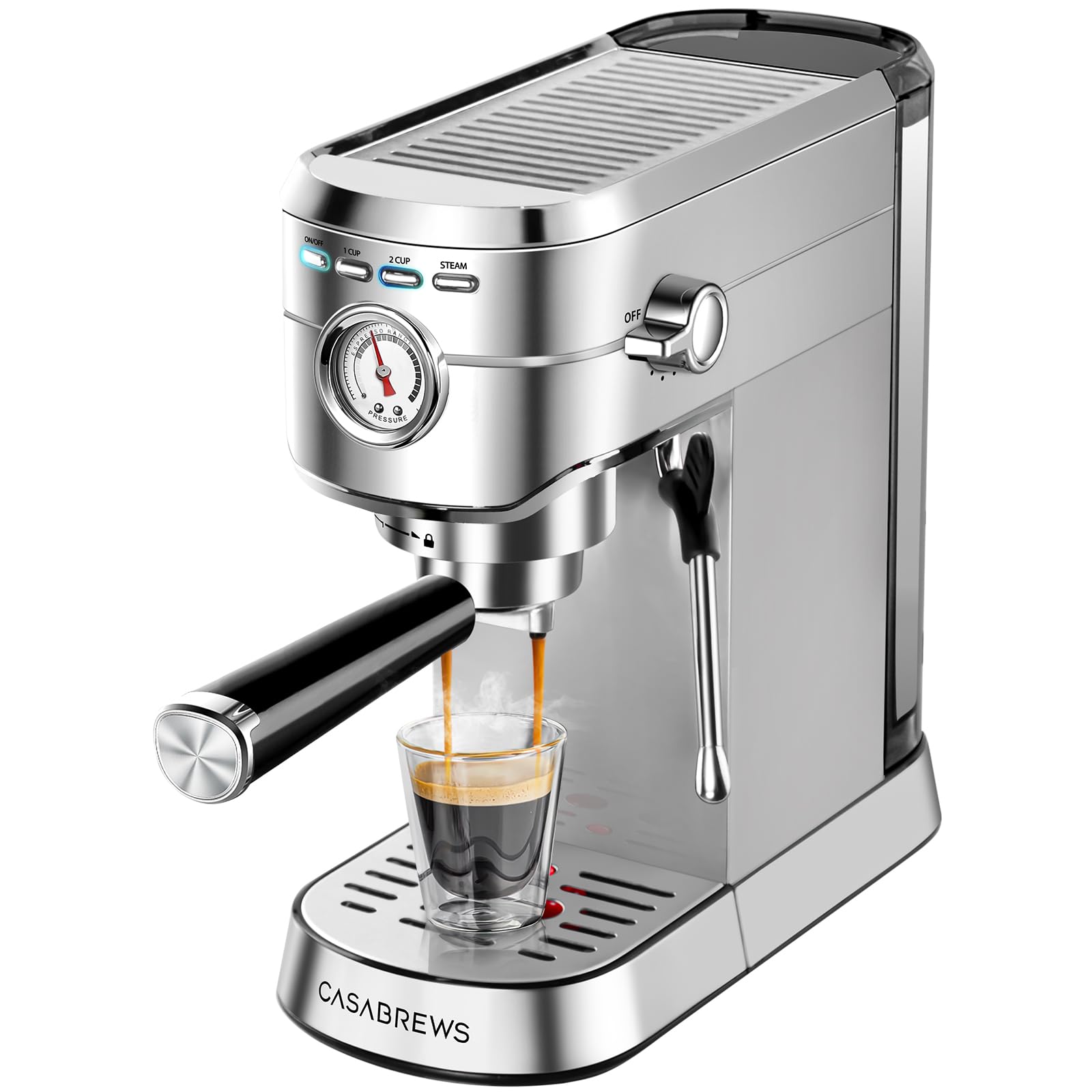
Best with pressure gaugeCASABREWS CM5418 Compact Espresso MachineA compact semi-automatic machine for learning milk drinks, with a built-in pressure gauge that shows how each shot is extracting.
$111.99Price as of Nov 25, 2026, 7:18 PM ET. Details
Espresso machines range from fully manual to push-button. If you are new to this, start with our guide to making espresso at home, then see machines under $500 if budget is the main limit.
Ease of use
Look at the machine type spec first. Manual and semi-automatic machines leave dosing, tamping and timing to you, which is rewarding but takes practice. Super-automatic machines handle those steps for you. NCA describes the manual routine as distributing the grounds evenly, then tamping them into a compact puck (NCA). If you want that routine, our guide to making espresso at home walks through it.
Grinder: built in or separate
NCA calls the espresso grind fine, like table salt (NCA). A built-in burr grinder saves counter space. A separate grinder takes more room but can be upgraded later and used for other brew methods. Check the built-in grinder column in the table, and compare separate options in our guide to espresso grinders.
Milk system
If you drink lattes or cappuccinos, the milk system is as important as the coffee side. A steam wand lets you texture milk by hand and rewards practice. An automatic system froths at a button press. If you only want foam, a separate milk frother can be cheaper than a machine with a built-in system.
Heat-up time and temperature stability
The traditional Italian espresso standard calls for water at the group between 90 and 96°C and pressure of at least 8 bar (COMITCAF). Listings rarely say how a machine holds temperature, so use the heating system column as a clue and check the manual for the warm-up routine. The pump pressure we list is the maker's figure, not a measurement.
Descale alerts and cleaning
Hard water forms scale when heated (USGS), so a descale alert is a practical feature. For coffee makers in general, NCA says major manufacturers recommend descaling at least every 3 to 6 months (NCA). Follow your machine's prompts and our descaling guide.
Tips for using your espresso machine
Buy or plan for a grinder before you buy the machine: espresso needs a fine grind, "like table salt", according to the NCA.
A scale makes it easy to hit a ratio of about 1 g of coffee to 2 g of espresso (NCA).
Read the descaling guide before you buy, so you know what upkeep the machine will need.
For the first weeks, aim for a shot of about 20 to 30 seconds of contact time (NCA). A machine with presets takes some of the guesswork out while you learn.
NCA says major manufacturers recommend descaling at least every 3 to 6 months (NCA). Where a machine has a descale alert, follow it, and use our descaling guide for the general routine.
FAQ
What pressure does espresso need?
The traditional Italian espresso standard asks for at least 8 bar at the group (COMITCAF). Makers often list pump pressure, but that is their figure and not a measurement of what reaches the coffee.
How long should a shot take?
NCA describes about 20 to 30 seconds of contact between the water and the coffee (NCA).
Do I need a separate grinder?
Espresso needs a fine grind, "like table salt" (NCA). You can buy a machine with a built-in burr grinder, or buy a separate grinder and pair it with the machine.
How often should I descale?
Follow your machine's alert first. As a general guide for coffee makers, NCA says major manufacturers recommend descaling at least every 3 to 6 months (NCA).
Why scale builds up, how often to descale and what to check in your manual.
Bloom & Burr
The Bloom & Burr Brew Ratio Cheat Sheet
Golden Ratio: 1-2 tablespoons of ground coffee per 6 oz of water.
Drip: medium grind, about 5 minutes of contact.
Pour-over: 1:13 to 1:16 by weight, medium grind, water at 93 ± 3°C, 2-4 minutes.
French press: 1:10 to 1:16, coarse grind, about 4 minutes.
bloom-and-burr.com
Get the Brew Ratio Cheat Sheet
A printable one-page sheet with the ratio, grind, time and temperature for drip, pour-over, French press, cold brew and espresso. Free, and sized for the cabinet door.