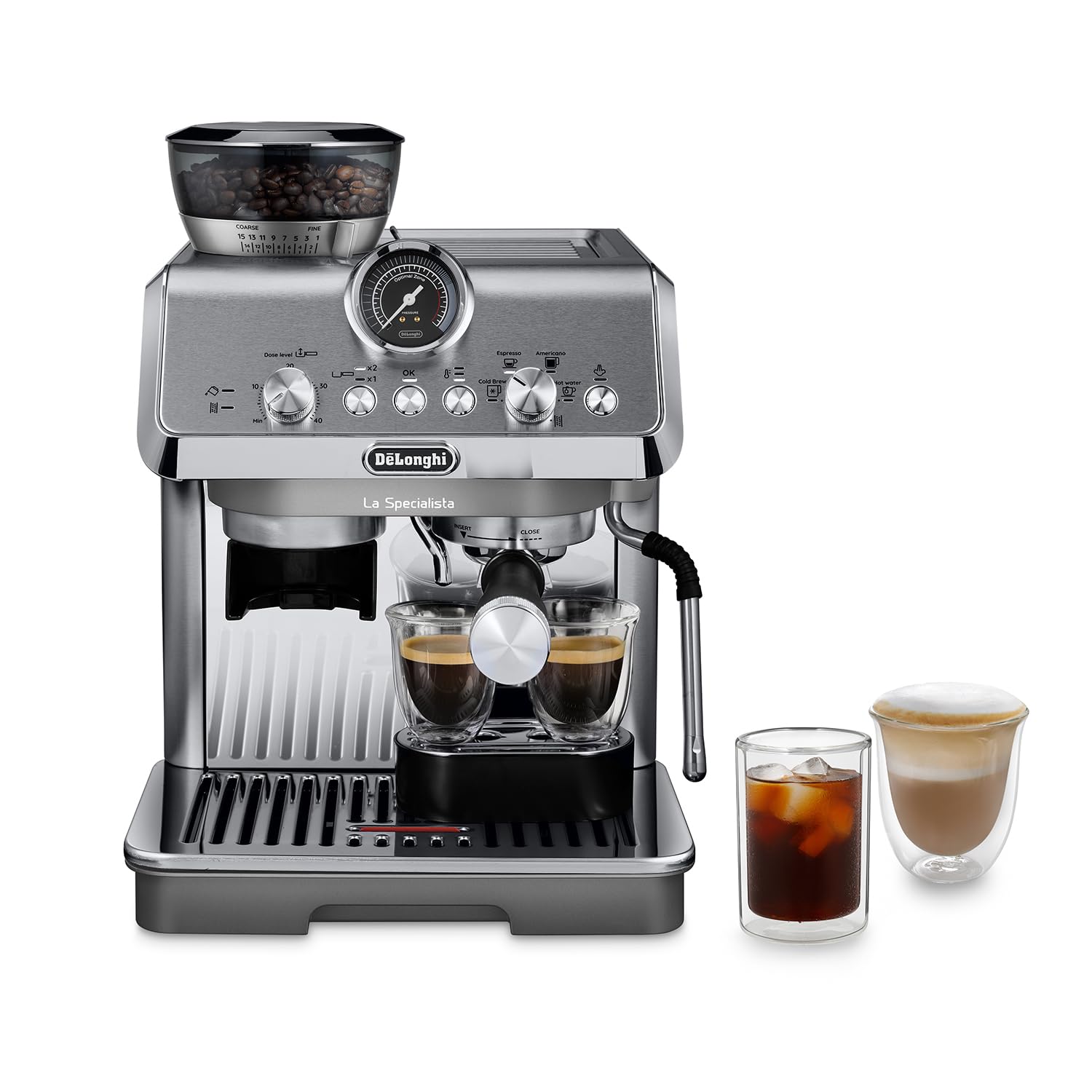
We compared manufacturer specs, manuals and warranty terms. We have not hands-on tested these products yet. How we research
We may earn a commission when you buy through links on this page. As an Amazon Associate I earn from qualifying purchases. How we make money
A machine with a built-in grinder takes care of two jobs on one footprint, which suits small kitchens and anyone who wants fewer parts to buy. The choice comes down to how much control you want over the grind and dose, and how automatic you want the rest. This page is for shoppers comparing super-automatic and semi-automatic models.
We compared 6 espresso machines with grinders and picked 6.
Our picks at a glance
1
★ Start hereBest overallBreville Barista ExpressA built-in conical burr grinder and steam wand, with one of the largest owner communities for tips.
$494.95Price as of Nov 26, 2026, 11:57 PM ET. Details
Best with PID controlGevi 20 Bar Espresso Machine with GrinderAn all-in-one for latte makers who want control: a built-in conical burr grinder, PID temperature control and a 58 mm portafilter.
$275.49Price as of Nov 25, 2026, 7:35 PM ET. Details
Check the grinder type and the number of grind settings. Burr grinders cut coffee to a set size, which gives more even results than blades. Espresso needs a fine grind, "like table salt" (NCA), so look for a range that reaches fine. Our burr vs blade guide explains the difference. Ask whether the settings are numbered steps or a smooth dial, and read the maker's description of the range, since settings numbers are not comparable between brands.
Dose control
Dose control sets how much coffee goes into each shot. Timed dosing runs the grinder for a set time, and weight-based dosing stops at a target weight. The traditional Italian standard uses 7 to 9 g of ground coffee for a single (COMITCAF), so check that the machine's dose range covers what you want.
Grinder cleaning
Look at how you reach the burrs and hopper. Removable hoppers and burrs that come out make cleaning quicker. The manual's cleaning steps for your model are the final word on what to do and how often.
Milk system
Semi-automatic models usually have a steam wand. Super-automatic models often froth automatically. Check the milk system column and compare options in our milk frother guide if you want a separate tool. If you want milk drinks every day, an automatic system saves effort, and a wand gives you more control.
Footprint and automation level
A super-automatic grinds, tamps and brews at the touch of a button. A semi-automatic lets you dose, tamp and time the shot. Check the dimensions column against your counter and the cabinet above it, then pick the level of control you will enjoy using every day. A compact footprint matters most if the machine lives under a cabinet, so measure the height as well as the width.
Tips for using your espresso machine with grinder
Aim for a ratio of about 1 g of coffee to 2 g of espresso (NCA); a small scale helps.
Follow the manual's cleaning steps for the grinder as well as the brew group.
Check the water tank size against how many drinks you make in a row.
Read the dimensions and water tank columns together, since a compact machine with a small tank needs refilling more often.
A built-in grinder still needs to reach a fine setting, since NCA lists espresso as a fine grind, like table salt (NCA). Check the grind settings column before you compare anything else.
NCA suggests about 1 g of coffee to 2 g of espresso and a contact time of 20 to 30 seconds (NCA). Our espresso at home guide walks through those steps for a semi-automatic machine.
FAQ
Should I get a built-in grinder or a separate one?
A built-in grinder saves space and means fewer things to buy. A separate grinder takes more room, but you can replace or upgrade it later without changing the machine.
What is the difference between super-automatic and semi-automatic?
A super-automatic machine grinds, tamps and brews at the touch of a button. A semi-automatic machine leaves the dosing, tamping and timing of the shot to you.
What ratio should I aim for?
NCA describes a ratio of about 1 g of coffee to 2 g of espresso, or 1:2 (NCA). A small scale makes that easier to hit.
How do I clean the built-in grinder?
Follow the cleaning steps in your model's manual. Those steps tell you which parts come out and how often to do it.
Even grinds and adjustability, or a simple chopper: which fits you.
Bloom & Burr
The Bloom & Burr Brew Ratio Cheat Sheet
Golden Ratio: 1-2 tablespoons of ground coffee per 6 oz of water.
Drip: medium grind, about 5 minutes of contact.
Pour-over: 1:13 to 1:16 by weight, medium grind, water at 93 ± 3°C, 2-4 minutes.
French press: 1:10 to 1:16, coarse grind, about 4 minutes.
bloom-and-burr.com
Get the Brew Ratio Cheat Sheet
A printable one-page sheet with the ratio, grind, time and temperature for drip, pour-over, French press, cold brew and espresso. Free, and sized for the cabinet door.